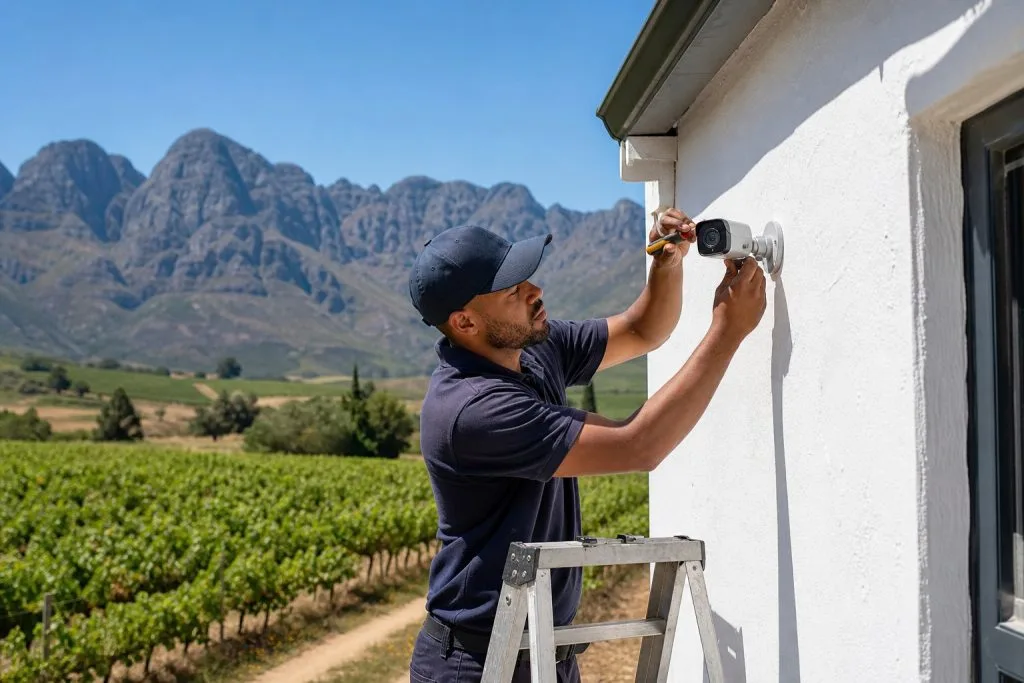
Cameras are only worth it if they cover the right ground. A practical guide to planning security that actually protects a Wellington property.
A camera system is only worth what it actually sees. We're often called to properties where cameras were fitted years ago, and yet the one angle that mattered, the gate or the back door, isn't covered at all. Good CCTV starts not with the cameras but with a plan: what you're protecting, where the risks are, and how you'll actually use the footage. On a winelands plot, with outbuildings, a long driveway and stretches of dark vineyard, that planning matters even more than it does in town.
Coverage before kit
Before choosing a single camera, walk your property and think about entry points: the gate, the front and back doors, the garage, any side access and the vehicles. A handful of well-placed cameras covering those beats a dozen pointed at empty lawn. We plan camera positions for real coverage: not blind spots, as the first step of any CCTV installation, because the layout is what makes the difference between footage you can use and footage that just fills a hard drive.
Night vision and the winelands dark
Out on a farm or a plot toward Bovlei, there's very little ambient light at night, which is exactly when you most want the cameras working. Decent infrared night vision is non-negotiable, and for key areas a camera with good low-light colour or a paired light makes identification far easier. Cheap cameras tend to give you a useless grey smear after dark; it's worth spending where it counts.
Recording, storage and remote viewing
- A recorder (NVR or DVR) with enough storage to keep a useful window of footage: a week or two, not a few hours.
- Remote viewing on your phone, so you can check the gate or a delivery from anywhere.
- Motion alerts on the cameras that matter, so you're notified rather than scrolling through hours of nothing.
- Sensible retention so older footage is kept long enough to be useful but doesn't overwrite the moment that counts.
Remote access is the feature people use most. Being able to glance at your phone and see the yard: whether you're at work in Paarl or away for the weekend, is what turns cameras from a grudge purchase into genuine peace of mind.
Power, weather and the things that break
Cameras live outside, so weatherproofing and tidy, protected cabling decide how long they last. And because security is most needed when the power's out, it's worth wiring the recorder and key cameras to backup: our guide to loadshedding-proofing your setup covers how. If you run a place to stay, security also forms part of the bigger picture we cover in getting guesthouse connectivity right.
The bottom line
Planning a system like this is exactly what we do as a trusted DStv installer in Wellington, covering CCTV alongside every satellite job.
Good CCTV isn't about the most cameras or the highest megapixel count on the box. It's about covering the right ground, seeing clearly at night, and being able to get to the footage when you need it. Plan it properly and a modest system protects a property far better than an expensive one pointed at the wrong places. We install and repair camera systems across Wellington and the surrounding farms: see where we work, and get in touch for an honest assessment of what your property actually needs.
Need a hand with this?
We are a quick call or WhatsApp away. Tell us what you are after and we will sort it: neatly, and the first time.
Get a quote →