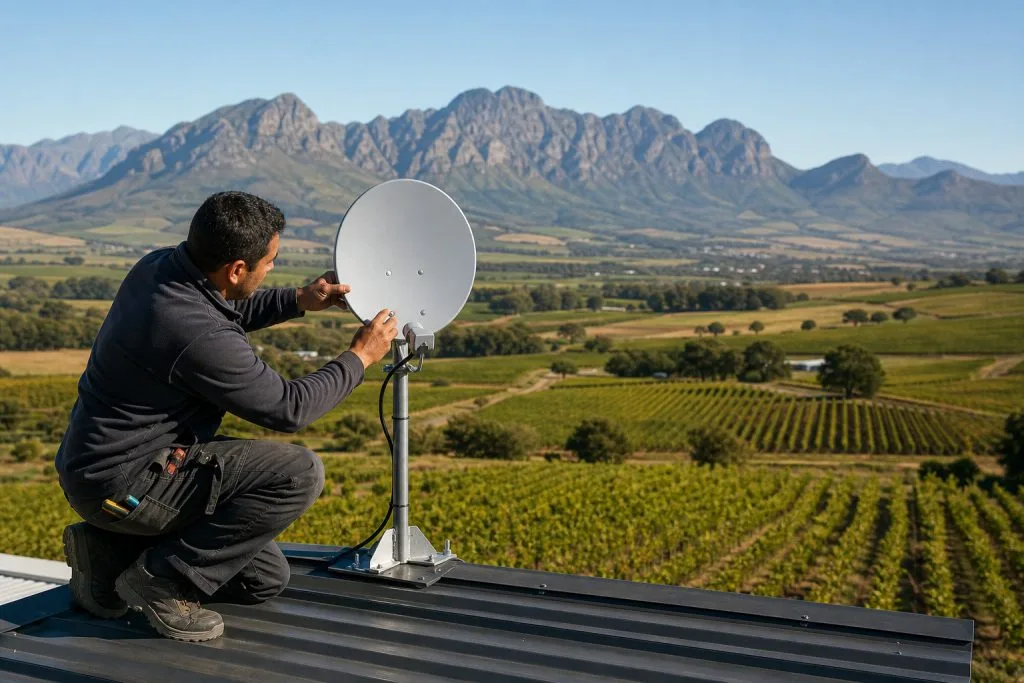
Mountains and mature oaks make Wellington beautiful, and tricky for satellite signal. Here's what actually matters when you're aiming a dish in the valley.
Satellite TV works on a simple principle that becomes surprisingly complicated in a place like Wellington: your dish needs a clear, uninterrupted view of a satellite sitting far out over the equator. We call that "line-of-sight", and on the flat parts of the country it's rarely a problem. In the Winelands, ringed by the Hawekwa and Groenberg, it's the single most important thing we check before we so much as lift a dish onto a roof.
Get it right and you'll have a picture that holds steady through a winter storm. Get it wrong and you'll be living with pixelation, freezing and "searching for signal" messages that no decoder swap or subscription call will ever fix. So it's worth understanding what's actually going on up there.
What gets in the way
The usual culprits are mountains, tall trees and neighbouring buildings, and in our area, all three turn up regularly. A beautiful old oak that shades the stoep in summer can also clip the signal path just enough to cause pixelation when the wind moves the branches. A ridge behind the house can block the satellite entirely from one corner of the roof while leaving another corner perfectly clear.
This is why we never guess. A quick on-site survey with the right tools tells us exactly where on your roof, or wall, or pole: the dish needs to sit. Sometimes the difference between a flawless signal and a frustrating one is two metres along the same roofline. It's exactly the kind of judgement call a proper new installation is built around, and it's why a tidy DIY job so often disappoints.
Why weather makes it worse
A dish that's only just scraping a usable signal on a clear day will be the first to drop out when rain rolls in off the mountains. Rain and heavy cloud weaken the signal slightly, so you want plenty of headroom. A properly aimed dish with a strong baseline reading keeps working in weather that would knock a marginal setup off the air. We dig into this in more detail in our guide to why signal drops when it rains, but the short version is that good line-of-sight is your first and best defence against weather.
The mountains cut both ways
The same terrain that makes line-of-sight tricky also makes precise aiming non-negotiable. On a mountain-edge property toward Bainskloof, the angle to the satellite might be tighter than it would be in the open valley, and the margin for error is smaller. That's where meter-accurate dish alignment earns its keep: we set elevation, azimuth and LNB skew to the degree and lock the mount down so the next southeaster doesn't undo the work.
What you can check yourself
- Has anything grown or been built since the dish went up? A tree or a new outbuilding can creep into the signal path over a couple of seasons.
- Does the picture only fail in bad weather, or all the time? Weather-only points to marginal aim; all-the-time points to a fault.
- Is the dish visibly loose, rusted or hanging at a slightly different angle than it used to? Wind and corrosion both move dishes.
- Did the trouble start right after a storm? That usually means the dish was knocked rather than the satellite "moving".
None of these need tools: just a look from the garden. If you spot a problem, it's far cheaper to have it sorted early than to wait for a total drop-out the night before a big match.
The takeaway
As the local DStv installers in Wellington, we check line-of-sight properly on every job: before a single bracket goes up.
If your picture pixelates in light rain, drops out in a storm, or has never been quite right, line-of-sight is the first thing to check: not the decoder. A few degrees of adjustment, a slightly higher mount, or a move to a clearer part of the roof often fixes it for good. That's exactly the kind of call a local installer who knows the valley can make in minutes. We work right across Wellington, Bovlei, Bainskloof and out toward Paarl: see the full list on our service areas page, and get in touch if you'd like us to take a look.
Need a hand with this?
We are a quick call or WhatsApp away. Tell us what you are after and we will sort it: neatly, and the first time.
Get a quote →