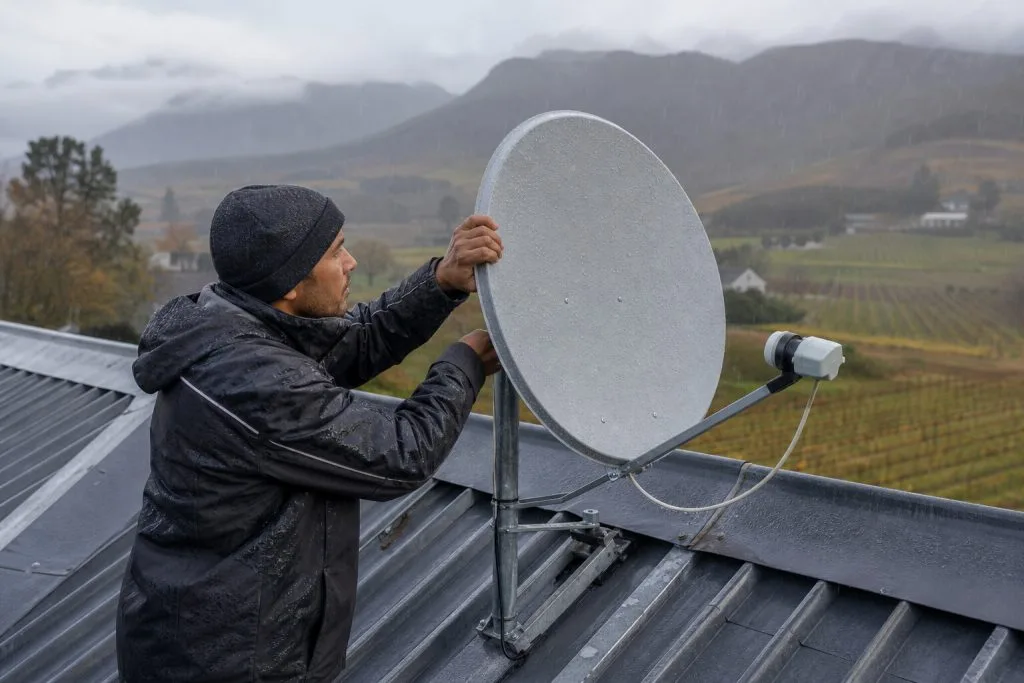
Rain-fade, a drifting dish or a tired LNB: most weather drop-outs trace back to a handful of causes. What to check, and when to call.
It's one of the most common calls we get in Wellington: "the picture's perfect until it rains, then it freezes or disappears." It's frustrating, it always seems to happen at the worst moment, and the good news is that it almost always traces back to a short list of causes. Here's what's really going on when weather knocks your signal, and what's worth checking before you call anyone out.
Rain-fade is real, but it shouldn't beat a good install
Satellite signal weakens slightly when it passes through heavy rain and cloud. That's "rain-fade", and a little of it is normal physics that affects everyone. The key thing to understand is this: a properly installed dish with a strong baseline signal has enough headroom to ride through ordinary winelands rain without you noticing. If your picture drops in light rain, or fails completely in a normal storm, the rain isn't really the problem: your signal margin is too thin to start with. That usually means aim or hardware.
The usual causes, in order
- A dish that's drifted off aim. Wind, a knock, or a slowly loosening bracket nudges the dish a degree or two off the satellite, eating your margin. This is the most common cause we find.
- A tired or water-damaged LNB. The arm at the front of the dish degrades over time, and a cracked cover lets moisture in, weakening reception: especially noticeable in wet weather.
- Water in the connectors or perished cable. A connector that isn't properly weatherproofed lets damp in, and the signal suffers exactly when it's raining.
- Line-of-sight that was always marginal. A tree that's grown into the signal path leaves you with no headroom for weather: there's more on this in our piece on why line-of-sight is everything in the Winelands.
What you can check yourself
Before booking a callout, it's worth a quick look. Is the dish visibly loose or sitting at a different angle than usual? Has a tree grown into its view? Does the trouble match the weather exactly, or is the picture iffy on clear days too? And on the decoder, the signal-strength and signal-quality screens (in the settings menu) tell a story: consistently low quality points to aim or hardware rather than your subscription. None of this needs tools, and it helps us bring the right parts when we come out.
When to call
If the dish has clearly moved, the LNB looks weathered, or the picture fails in weather that ought to be no trouble, it's a job for a proper repair. We diagnose the real cause with a signal meter rather than guessing, realign to true line-of-sight, and replace only what's actually worn: that's the core of our DStv signal repair service. If the aim is the issue, a precise dish realignment restores the headroom that keeps you watching through the next storm.
The bottom line
If your setup keeps failing every time the weather turns, it's worth getting it looked at by a proper DStv installation Wellington team rather than living with it.
Weather drop-outs are rarely about the weather: they're about a signal that no longer has room to spare. Sort the aim, the LNB and the weatherproofing, and your picture rides through the rain the way it should. We cover Wellington town and the surrounding farms and estates; see our service areas and get in touch if your signal can't handle a shower.
Need a hand with this?
We are a quick call or WhatsApp away. Tell us what you are after and we will sort it: neatly, and the first time.
Get a quote →